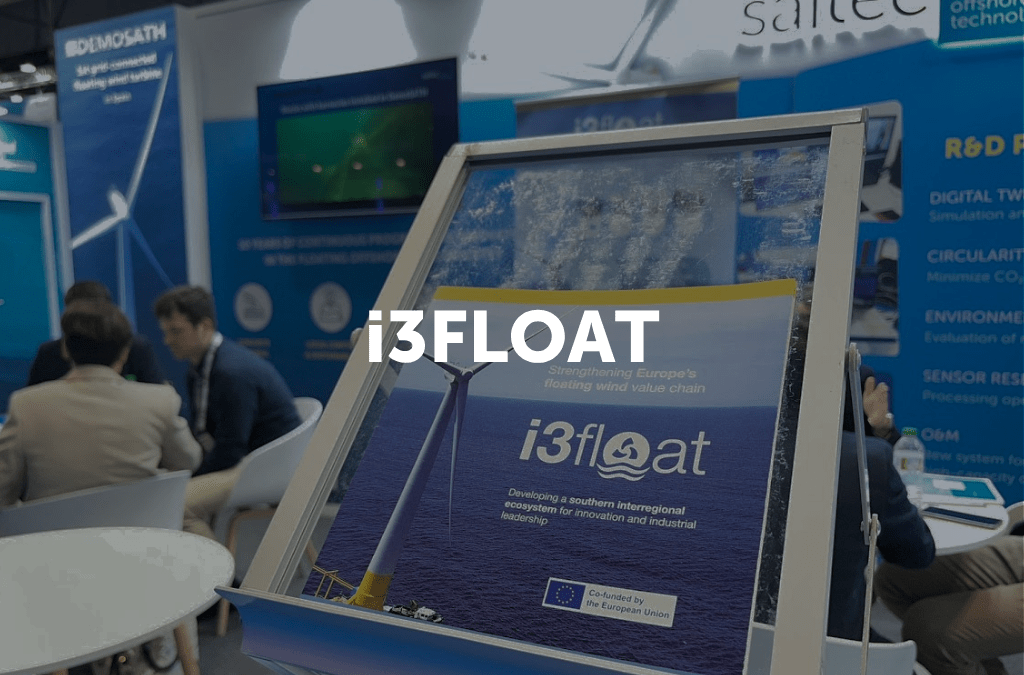
Moving floating offshore wind forward requires collaboration and innovation. To scale up and present an energy source that is both reliable and cost-competitive, Saitec Offshore Technologies has integrated into Pilot 1 of the European I3FLOAT Project.
The I3FLOAT Framework
Co-funded by the European Union under the I3-2024-INV1 call, I3FLOAT is a 36-month initiative that brings together 24 partners, including Saitec and Saitec Offshore Technologies, across 8 countries. The objective is strictly operational: testing pioneering technologies in real-world environments to reduce uncertainties, lower the levelized cost of energy, and build a robust interregional supply chain.
Driving SATH Technology Forward in Pilot 1
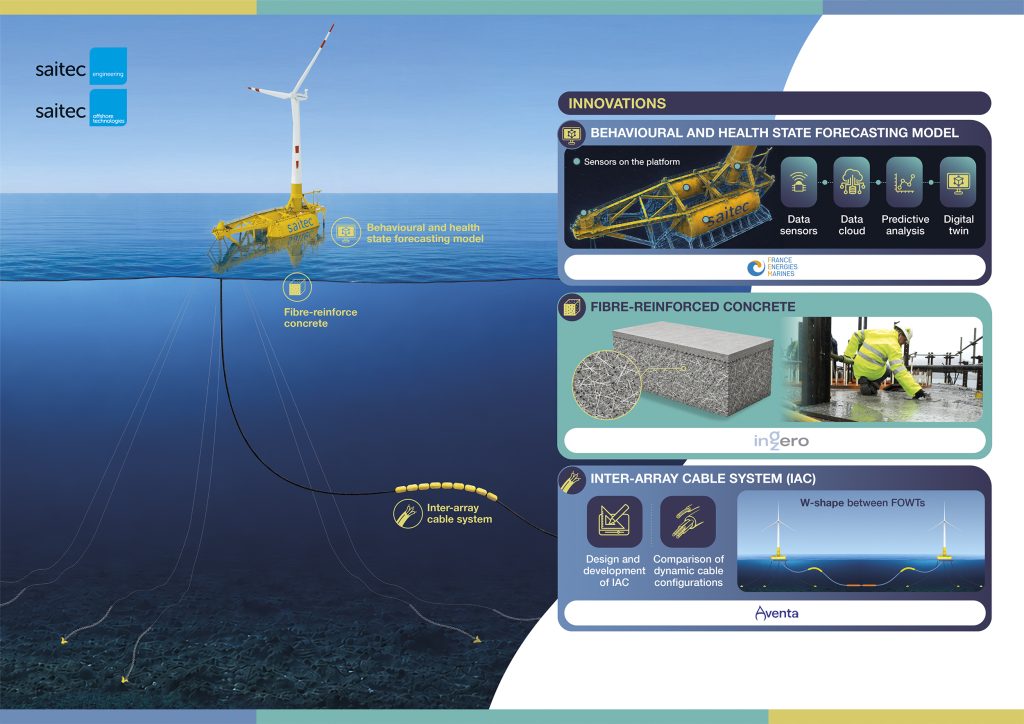
Within this project, Pilot 1 serves as the testing ground for innovations surrounding our SATH (Swinging Around Twin Hulls) technology. We are working directly on three core technical areas alongside specialized partners:
Partner
Innovation Area
Core Focus
Aventa
Inter Array Cable (IAC) System
Metocean analysis, cross-section electrical design, and mooring configurations.
France Énergies Marines (FEM)
Digital Twin & Forecasting
Real-time sensor integration, aero-servo-hydro-elastic modeling, and AI.
IngZero
Fiber Reinforced Concrete
Structural innovations, fatigue analysis, and industrialization processes.
Detailed Scope of Works
In the framework of this project, we are working on the following specific innovations to optimize platform performance and reliability:
Inter Array Cable (IAC) system with Aventa
The project involves the selection of 2 installation sites: Galicia with a 150m water depth and the Gulf of Lion with a 65m water depth.
The engineering teams are executing the cross section design, which includes the electrical definition of the section and local analysis.
Work also includes the design of the mooring system configuration for the Galicia site.
DemoSATH Digital Twin and Forecasting model, in collaboration with France Energies Marines (FEM)
To increase simulation fidelity, real physical measurements are fed into the numerical model.
A primary objective is the behavioural and health state forecasting model development.
This forecasting capability is achieved by using AI techniques and neural networks to learn dependencies between variables.
Fiber reinforced concrete alongside with IngZero
Focus on the development of structural innovations, considering high-strength concrete, fiber reinforced concrete or steel for specific parts of the SATH floating platform.
A key task is to determine how fatigue aspect affects the design of the platform or its parts.
We are conducting a comparative economic study between the fiber-reinforced concrete and high-strength concrete or even steel for specific parts.
The ultimate goal is to define durability strategies to increase lifespan and reduce maintenance costs.
The engineering activities within Pilot 1 are already in progress. The data, validated designs, and forecasting models obtained from these three areas will be directly applied to optimize the next iterations of the SATH platform.
This website uses cookies so that we can provide you with the best user experience possible. Cookie information is stored in your browser and performs functions such as recognising you when you return to our website and helping our team to understand which sections of the website you find most interesting and useful.
Strictly Necessary Cookies
Strictly Necessary Cookie should be enabled at all times so that we can save your preferences for cookie settings.
If you disable this cookie, we will not be able to save your preferences. This means that every time you visit this website you will need to enable or disable cookies again.
3rd Party Cookies
This website uses Google Analytics to collect anonymous information such as the number of visitors to the site, and the most popular pages.
Keeping this cookie enabled helps us to improve our website.
Please enable Strictly Necessary Cookies first so that we can save your preferences!



 English
  Spanish