The selection of materials for floating wind structures is far from arbitrary, it’s a meticulous process that balances technical requirements, cost efficiency, and local conditions. The DemoSATH project exemplifies this approach, showcasing how a well-analyzed material choice can drive success.
The material dilemma
Floating wind platforms traditionally rely on steel or concrete, each material offering unique advantages and facing specific challenges. Steel, widely used in marine environments, is valued for its high strength-to-weight ratio. However, it is also subject to price volatility, global supply chain dependencies, and elevated corrosion and maintenance costs. In contrast, concrete offers greater cost stability, local material availability, and long-term durability with minimal maintenance requirements, and overall good durability against chemical attacks such as chlorides and sulfates.
Saitec Offshore Technologies chose concrete for its DemoSATH project—the first floating wind unit connected to the grid in Spain—highlighting the material’s suitability for offshore renewable energy applications.
Advantages of using concrete in offshore floating wind platforms
Superior resistance to marine corrosion The marine environment is highly corrosive due to salt, humidity, and thermal cycles. Properly designed reinforced concrete, with adequate cover and corrosion-inhibiting additives, exhibits much greater durability than steel, reducing the need for costly protective systems like cathodic protection or coatings.
Lower construction and maintenance costs Concrete platforms benefit from lower initial construction costs and significantly reduced maintenance over their lifespan. Offshore maintenance is costly and logistically complex, so minimizing interventions during the 20–30 year service life results in substantial economic savings and reduced operational downtime.
Favorable dynamic performance and structural stability Thanks to its high mass, concrete improves the dynamic behavior of wind turbines by damping cyclic loads and fatigue stresses on the tower, enhancing overall stability and potentially extending component lifespan.
Local availability and economic impact Concrete materials are often locally available near coastal offshore sites, enabling on-site or near-port fabrication. This proximity reduces logistical costs and carbon emissions. It also opens opportunities for local construction firms, promoting employment and economic growth in the region.
Adaptability to prefabrication and modular construction Concrete sections can be prefabricated in controlled environments such as dry docks or factories, then transported and assembled afloat or at port. This modular approach improves construction speed, quality control, and design flexibility, allowing innovative platform configurations tailored to project requirements.
Environmental and ecosystem benefits Compared to steel, concrete has a lower carbon footprint, contributing to greater environmental sustainability. Additionally, it reduces underwater noise transmission during operation, which is beneficial for marine ecosystems.
Extended service life and lifecycle cost efficiency Concrete platforms typically have a longer operational lifespan, which translates into lower lifecycle costs due to reduced need for repairs and replacements.
Concrete in the Manufacturing of DemoSATH
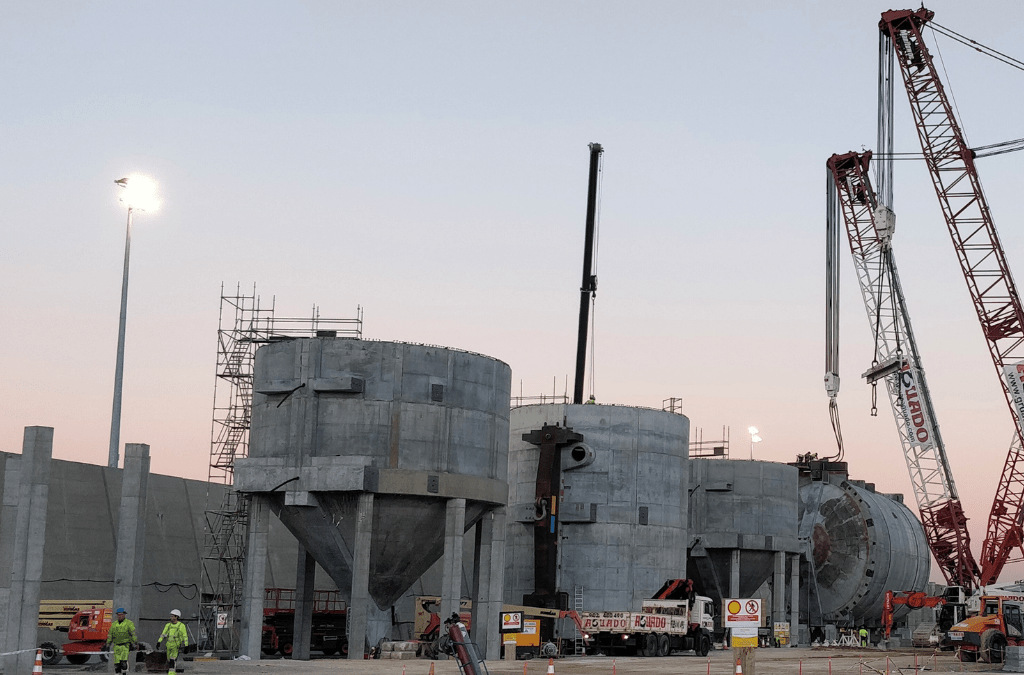
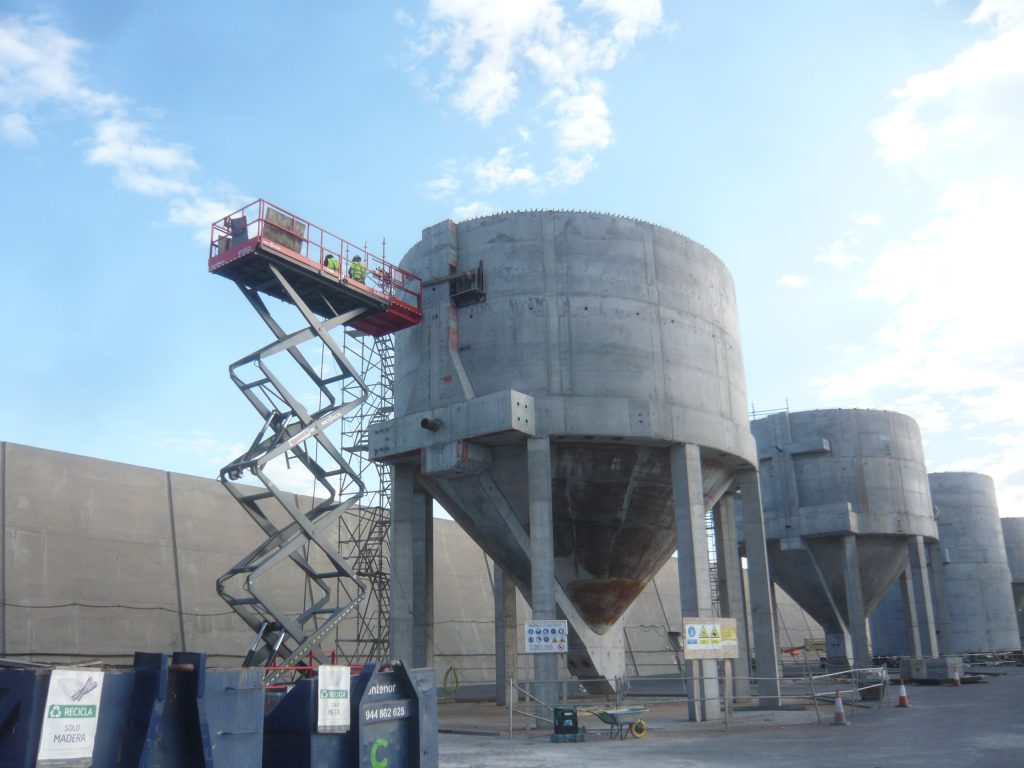
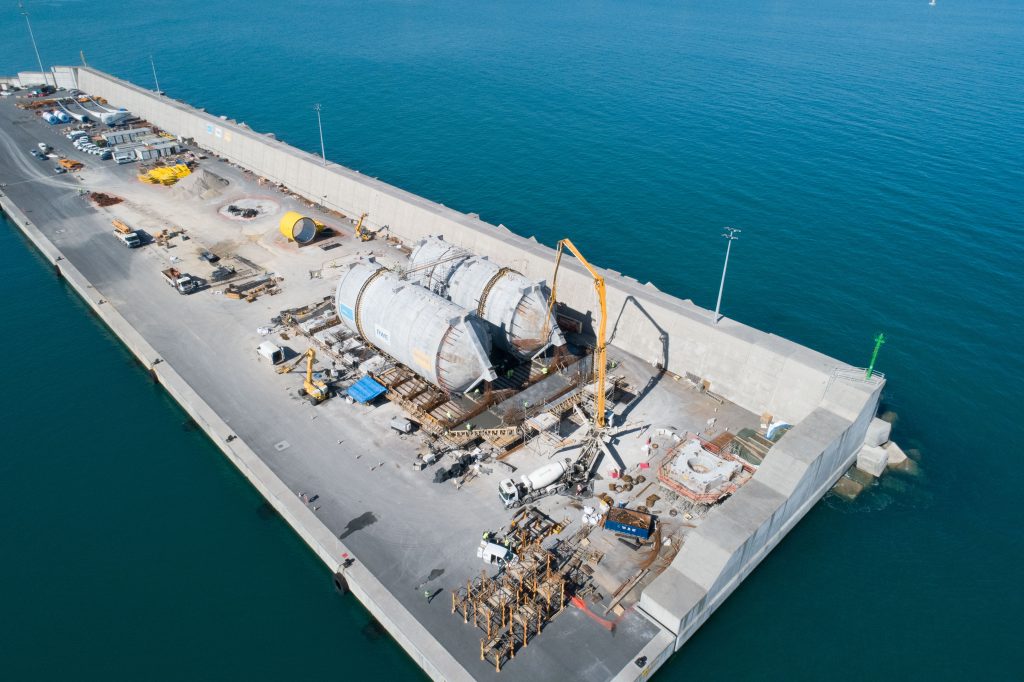
In the DemoSATH project, 90% of the concrete volume used in the construction of the floating platform resulted from a new and specific mix design developed as part of this R&D initiative. This mix was employed in the heave plate, the frames connecting the structure, the floaters, parts of the single point mooring system, and the transition piece. It was required to meet several key criteria:
Achieving high early-age strength
Reaching a final compressive strength of at least 50 MPa, and maintaining a reduced density—between 15% and 25% lower than that of conventional concrete.
These performance targets were achieved through the development and analysis of a tailored concrete formulation, which included the selection of cements resistant to saline environments and capable of delivering high early strengths, the use of low-density aggregates compatible with high-strength performance, and the incorporation of specific admixtures.
Initial characteristic tests were carried out to verify both the desired mechanical properties and the workability of the mix. Furthermore, the construction process involved thorough quality control through non-statistical monitoring: concrete samples were taken from every single mixer truck delivering concrete to the site, ensuring rigorous traceability and compliance throughout the execution phase.
Innovation for enhanced performance and reduced environmental impact
Saitec Offshore Technologies continues to innovate in the use of concrete for offshore wind applications, particularly in the development of floating platforms for future wind energy projects.
As part of its R&D strategy and through the FLOWIND project, the company is focused on developing more sustainable eco-concretes that incorporate eco-cements with a high clinker substitution rate (≥40%), aiming to significantly reduce the carbon footprint.
In addition, through theFLOAT&M initiative, Saitec has advanced the development of ultra-high-performance concretes (UHPC) reinforced with two types of polymer fibers, as well as a novel type of eco-concrete.
These advanced materials are also designed to offer improved fatigue resistance and durability, which is key to minimizing maintenance requirements and simplifying installation in offshore conditions. Through these innovations, Saitec positions concrete as a strategic material for scalable, cost-effective, and environmentally responsible offshore wind solutions.
Concrete offers a strong long-term advantage. When properly designed, it can withstand between 50 and 100 years in a marine environment without significant deterioration. This means fewer replacements and repairs and, consequently, that the higher emissions (those from initial production) are spread over a much longer service life. In other words, each MWh generated over the platform’s lifetime “carries” fewer emissions, which significantly improves the environmental balance.
Concrete stands out for its ecological compatibility, as it does not release toxic compounds into the marine environment during use, nor does it require polluting coatings. It allows colonization by organisms and good ecological integration, creating habitats that can potentially provide benefits to marine ecosystems, support the resilience of threatened species, and even become “de facto” protected natural areas.
This website uses cookies so that we can provide you with the best user experience possible. Cookie information is stored in your browser and performs functions such as recognising you when you return to our website and helping our team to understand which sections of the website you find most interesting and useful.
Strictly Necessary Cookies
Strictly Necessary Cookie should be enabled at all times so that we can save your preferences for cookie settings.
If you disable this cookie, we will not be able to save your preferences. This means that every time you visit this website you will need to enable or disable cookies again.
3rd Party Cookies
This website uses Google Analytics to collect anonymous information such as the number of visitors to the site, and the most popular pages.
Keeping this cookie enabled helps us to improve our website.
Please enable Strictly Necessary Cookies first so that we can save your preferences!



 English
  Spanish