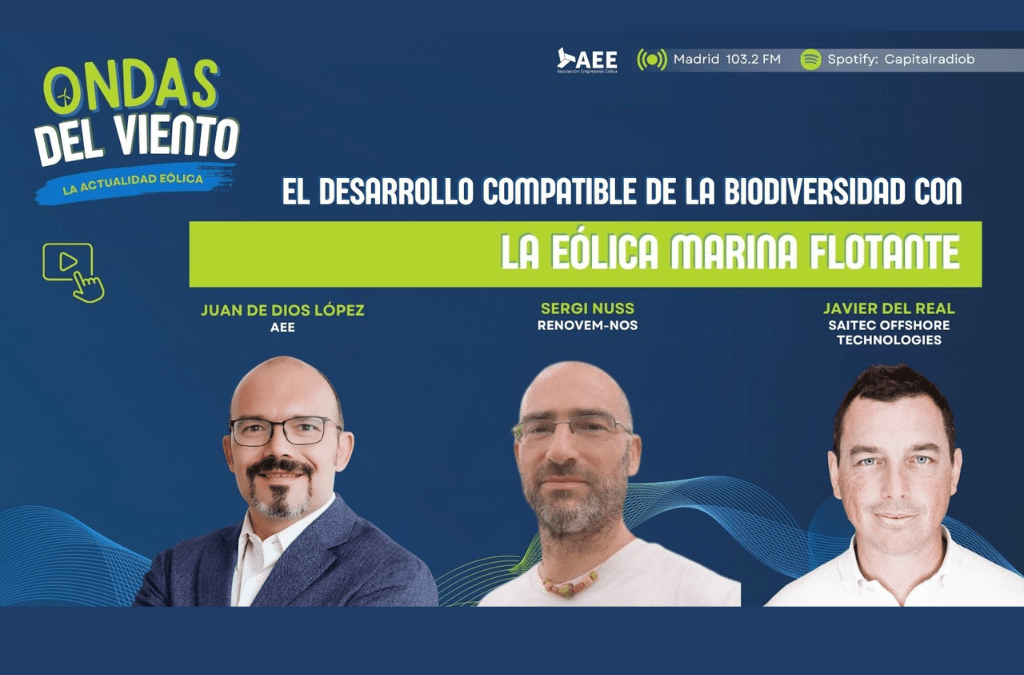
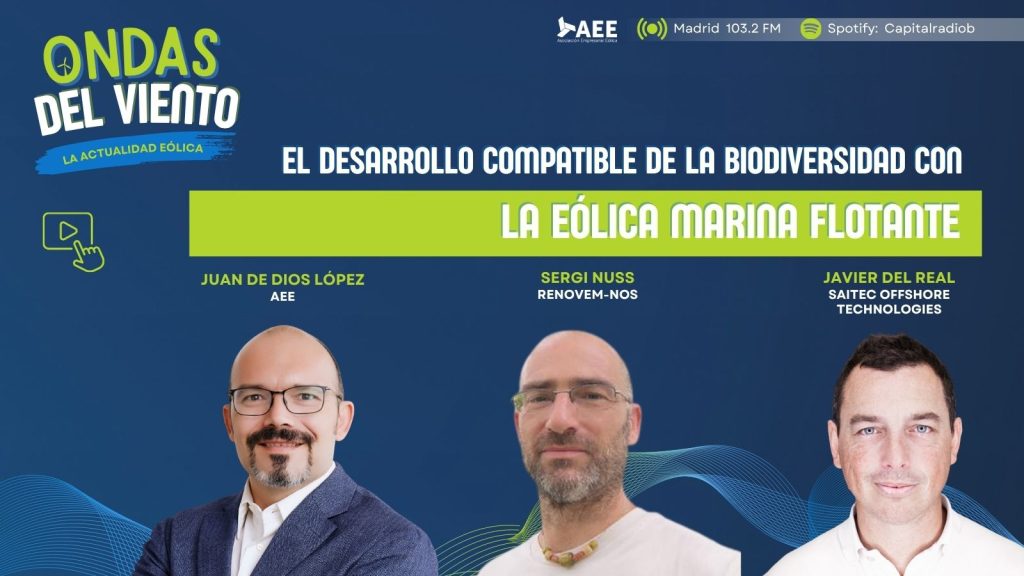
Javier del Real, biologist and Head of the Environmental Department at Saitec Offshore, took part in a sector discussion promoted by the Spanish Wind Energy Association on the coexistence between floating offshore wind and marine biodiversity.
The Spanish Wind Energy Association, one of the main wind energy sector organisations in Spain, recently dedicated an episode of its programme “Ondas del Viento” to one of the key challenges facing offshore renewable energy: how to develop floating offshore wind while ensuring the protection of marine ecosystems.
The programme brought together representatives from the wind sector, environmental experts and communication professionals to discuss the coexistence between offshore wind farms and biodiversity, the importance of scientific evidence, and the role of pilot projects in generating reliable knowledge.
Saitec Offshore participated in the discussion through Javier del Real, biologist and Head of the company’s Environmental Department, who shared the experience gained through the development and environmental monitoring of Saitec Offshore’s floating wind technology off the Basque coast. This work is part of the Demosath Lab programme, an initiative focused on generating scientific and technical knowledge around floating offshore wind and its interaction with the marine environment.
Environmental monitoring as a key pillar of floating offshore wind
During his intervention, Javier explained that Saitec Offshore is developing its own concrete floating platform technology and highlighted the importance of combining technological innovation with rigorous environmental research.
“We realised that the environmental aspect had to be fully monitored. What we learn from this platform can be applied to future offshore wind developments in Spain,” said Javier del Real.
The company’s environmental work within Demosath Lab includes monitoring different aspects of the marine environment, such as birds, bats, underwater organisms, fish, invertebrates, algae, invasive species, underwater noise and navigation.
“We had never devoted so much effort to a single technological and environmental project. We have obtained a great deal of information, although there are still issues that require further scientific study and validation,” he added.
Observing the interaction between floating platforms and marine life
One of the topics addressed during the discussion was the potential reserve effect that may occur around floating offshore wind platforms. According to Javier del Real, observations carried out around Saitec Offshore’s platform point to a greater presence of species in its surroundings.
“What we are observing is that, in general, there is a higher number of species around the platform, and everything indicates that there could be a reserve effect of species remaining in its surroundings,” he explained.
A debate based on evidence and scientific knowledge
The discussion also included Juan de Dios López, Technical Director of the Spanish Wind Energy Association, who provided context on the development of offshore wind in Spain and stressed the need to base public debate on data and evidence.
“The area available for offshore wind development in Spain represents less than 0.46% of the territorial sea, so we are talking about a very limited localised effect,” said Juan de Dios López.
He also underlined the value of pilot and demonstration projects, which make it possible to gather information from real offshore wind applications in real marine environments.
“These experimental installations make it possible to obtain information from real applications, with realistic dimensions and in equally realistic environments,” he stated.
Fighting misinformation around offshore wind
Sergi Nus, Director of Renovem-NOS, emphasised the importance of combating misinformation and approaching the debate on floating offshore wind from a scientific and proportionate perspective.
“We should not be afraid of science. Experimental projects are precisely what allow us to obtain results that can later support decision-making,” said Sergi Nus.
He also noted that offshore infrastructure equipped with monitoring systems can contribute to improving knowledge of the marine environment, which remains complex and difficult to study.
“The marine environment is still relatively unknown because it is not easy to investigate. Having modern monitoring systems will allow us to gain much better information about what is happening to it,” he added.
At the end of the programme, Piluca Núñez, Communications Director of the Spanish Wind Energy Association, highlighted the importance of dialogue between companies, institutions and local communities in the development of wind energy projects.
“We are talking about dialogue and good practices. We want to promote a positive relationship between the companies developing wind farms and the municipalities that host them,” said Piluca Núñez.
Through DemoSATH Lab project, Saitec Offshore continues to advance technological solutions that contribute to decarbonisation while generating valuable environmental information for the future deployment of offshore wind worldwide.





 English
  Spanish