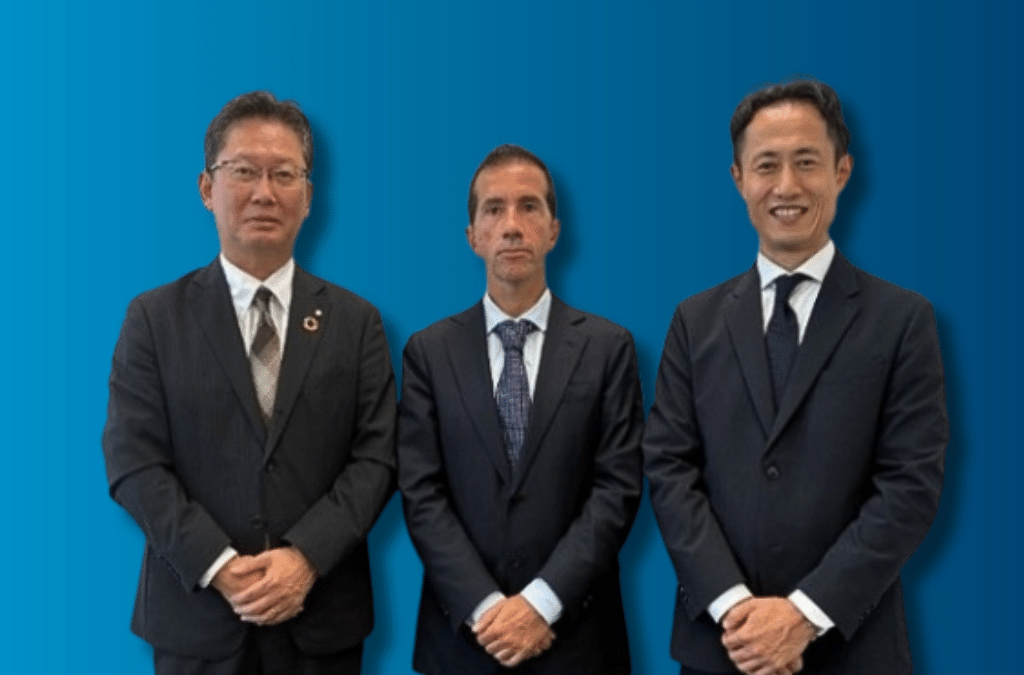
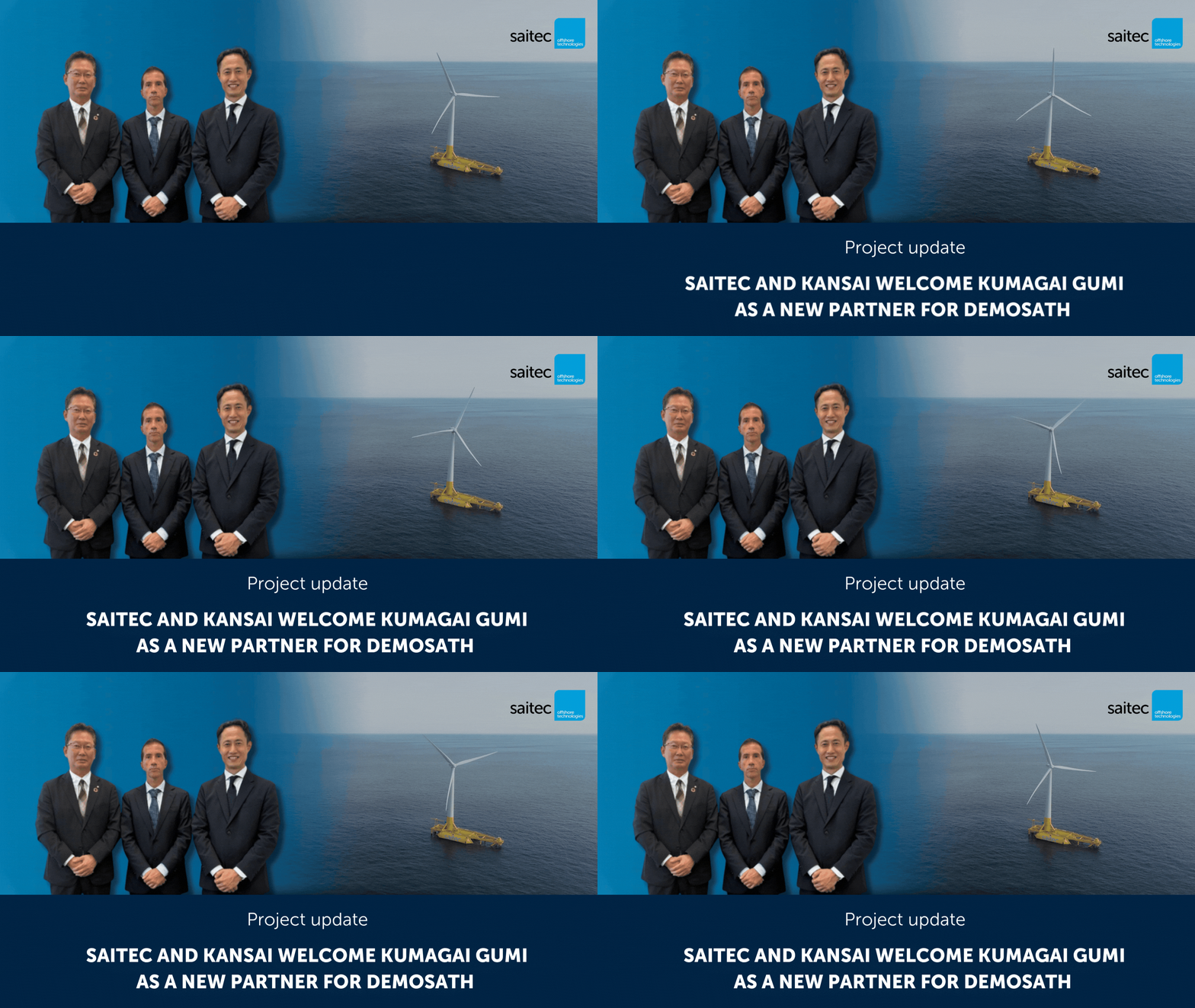
The DemoSATH project welcomes Japanese company Kumagai Gumi as a strategic project partner and begins a new phase focused on research, innovation and knowledge generation to advance the development of floating offshore wind.
The cooperation agreement signed by Saitec Offshore Technologies, The Kansai Electric Power Company Co. Inc. (KEPCO) – a company already involved in the project – and Kumagai Gumi will extend the operation of the DemoSATH prototype at the BiMEP open-sea test site (Armintza, Bizkaia, Spain), extending its operational life through 2027. During this period, work will focus on research, optimisation and knowledge transfer activities.
Kumagai Gumi joins this project to contribute its specialized expertise as a general contractor in the construction sector. Specifically, the company will focus on optimizing future decommissioning methods and evaluating rationalized construction procedures for mass production.
From technology demonstrator to research platform
DemoSATH consists of a 2 MW wind turbine mounted on a concrete twin-hull floating structure and is installed approximately 3.2 kilometres off the Basque coast, in water around 85 metres deep. It was constructed and assembled at the Port of Bilbao before being towed to its location at BiMEP.
This new phase begins three years after DemoSATH started operations and represents a natural evolution of the project. During this period, the demonstrator has enabled the installation, operation and power generation of the SATH floating technology to be validated under real offshore conditions, while also collecting data on its structural, dynamic and operational behaviour. In parallel, through its DemoSATH Lab project, it has served as a living laboratory to test trial systems and solutions designed to support coexistence with the marine environment, promote biodiversity and explore potential aquaculture-related applications.
Since it began operating, the floating wind turbine has been exposed to the demanding conditions of the Cantabrian Sea, withstanding waves of up to 13 metres and wind gusts of 144 km/h. The instrumentation installed on DemoSATH and its monitoring systems have made it possible to collect operational data under real conditions and compare its behaviour with the models developed during the design phase.
With the technical feasibility of the SATH Technology now demonstrated, the project is evolving to use this infrastructure and the accumulated experience as a full-scale research and testing platform, with the aim of transferring the lessons learned to future large-scale commercial projects in different international markets.
New research and testing areas in floating offshore wind
These activities will cover a broad range of research and testing areas related to floating offshore wind, including optimised monitoring of key system components, data analysis and predictive modelling, and the characterisation of the response of floating wind systems under a wide range of offshore conditions.
The research will leverage the extensive operational data generated by DemoSATH to further enhance the understanding of floating wind technology and support the development, design and optimisation of future commercial-scale floating offshore wind projects.
With Kumagai Gumi joining the project and operations extended through 2027, DemoSATH therefore moves from an initial phase focused on demonstrating the technology to a new phase aimed at generating knowledge for commercial application, strengthening its role as a reference platform for the development of floating offshore wind.



 English
 Spanish